Start building a more resolutive network
Book a demo and we'll show you the impact with your network's own numbers.
We compared Teral AI with Claude Sonnet 4.5 across 300 real specialist consultations in three specialties. Retrieval provides its greatest advantage where clinical practice needs it most.

Teral AI is an agent within the platform that any physician can consult through a chat. Unlike a general-purpose LLM, it has access, through semantic search over Vertex AI Search, to more than 6,000 resolved and fully anonymized clinical cases published by real physicians in previous specialist consultations.
The hypothesis we wanted to test was simple: for specific medical tasks, an agent with access to real clinical precedents should respond better than a general-purpose model of a comparable tier without that context. If the hypothesis holds, it validates both the product architecture and the value of the dataset that Teral physicians have built through their specialist consultations.
We chose Claude Sonnet 4.5 for comparison because it is a frontier general-purpose model in a tier comparable with the Gemini model on which Teral AI is built. We wanted to measure the impact of retrieval, not the gap between base models.
Teral AI outperformed Claude across all five evaluated dimensions. The following table shows average scores across the 300 benchmark cases.
| Dimension | Teral AI | Claude Sonnet 4.5 | Δ |
|---|---|---|---|
| Diagnostic accuracy | 4.62 | 4.15 | +11.3% |
| Treatment quality | 3.92 | 3.32 | +18.1% |
| Complementary tests | 4.10 | 3.33 | +23.1% |
| Overall quality | 4.65 | 4.27 | +8.9% |
| Clinical safety | 4.77 | 4.50 | +6.0% |
| Total score (out of 25) | 22.07 | 19.57 | +12.8% |
When we compare the result case by case instead of using averages, Teral AI won more than twice as many specialist consultations as Claude.
We designed the benchmark to be comparable, blinded, and based on real rather than synthetic cases.
We selected 300 real specialist consultations published by physicians on the Teral platform, divided equally among three specialties: dermatology, orthopedics and trauma, and otolaryngology. Every case had at least one substantive comment (30 characters or more) from a specialist, meaning it included a reference clinical response written by a real physician.
Both services received exactly the same prompt, including the clinical case description and a shared response structure: analysis, differential diagnoses, suggested tests, treatment, and recommendations. Teral AI could search its database for similar cases while generating its response; Claude relied exclusively on its general knowledge.
We used Gemini 2.5 Flash as the automated judge. Responses were presented without identifying their source and in random order for each case to reduce positional and brand bias. The judge scored five dimensions on a scale from 1 to 5:
Teral AI's advantage is not distributed equally across dimensions. It grows where access to similar cases matters most, such as recommending specific tests, combining treatments, and prioritizing diagnoses. It narrows where both models already start from a high baseline, such as clinical safety.
This makes clinical sense. When a general-purpose model encounters a case involving erythematous lesions on the lower limbs, it must reason from general principles. Teral AI can search for previous cases with similar clinical presentations that already have a confirmed diagnosis and specialist-documented treatment. It can use that real evidence to prioritize diagnoses, recommend specific studies, and propose management with concrete doses and durations.
Clinical safety, by contrast, is already a high baseline for both models. Modern LLMs are trained to be conservative in medical recommendations, so additional context contributes less when performance is already near the ceiling.
The advantage holds across all three specialties, with differences ranging from 2.2 to 3.0 points out of 25.
Dermatology, with almost four times as many indexed cases as orthopedics, shows the largest advantage. However, the difference between orthopedics and otolaryngology is nearly identical despite their different case volumes. Our preliminary interpretation is that more indexed cases create a larger advantage, but with diminishing returns. Moving from zero to a few hundred cases appears to provide most of the value; additional cases refine it.
A benchmark is only as useful as it is honest. These are the limitations we want to state openly, along with the next steps we have already identified.
We used Gemini 2.5 Flash as the judge because it is neither of the two services being evaluated. However, Teral AI is built on Gemini + tools, so it shares a base-model family with the judge. We do not yet know the magnitude of the bias this may introduce. For the next benchmark iteration, we plan to run a human validation with clinical specialists on a subsample and report the correlation between human and automated scores.
The three specialties evaluated have the highest case volume on the platform, which also makes them the best possible setting for retrieval. We do not yet know how Teral AI performs in specialties with few indexed cases or in areas such as internal medicine or pediatrics.
Specialist responses in real consultations may be brief, informal, or incomplete. They are the data we have on how a physician responds in practice, but they do not necessarily represent the ideal clinical gold standard. The judge qualitatively assessed the completeness and relevance of each response; it did not compare them directly with the real physician’s response.
This first report presents differences in means. In the next version, we will include confidence intervals, paired statistical tests, and score-distribution analysis to distinguish real differences from noise.
None of these limitations invalidate the main result, but they do define its scope. The benchmark shows that access to real clinical cases materially improves an LLM's responses in dimensions where precedents matter. It does not yet show whether that advantage leads to better clinical decisions in practice. That is a different question, and we will answer it through studies designed for that purpose.
This benchmark is the first public version of an evaluation process that we intend to run regularly. The next steps are:
We will continue publishing the results here. If you are a physician and would like to try Teral AI, you can do so in the app or at chat.teral.ai.
claude-sonnet-4-5-20250929. The Teral AI agent uses Gemini as its base model with retrieval over Vertex AI Search. The evaluation dataset, prompts, and benchmark scripts are available for review by the clinical and research team.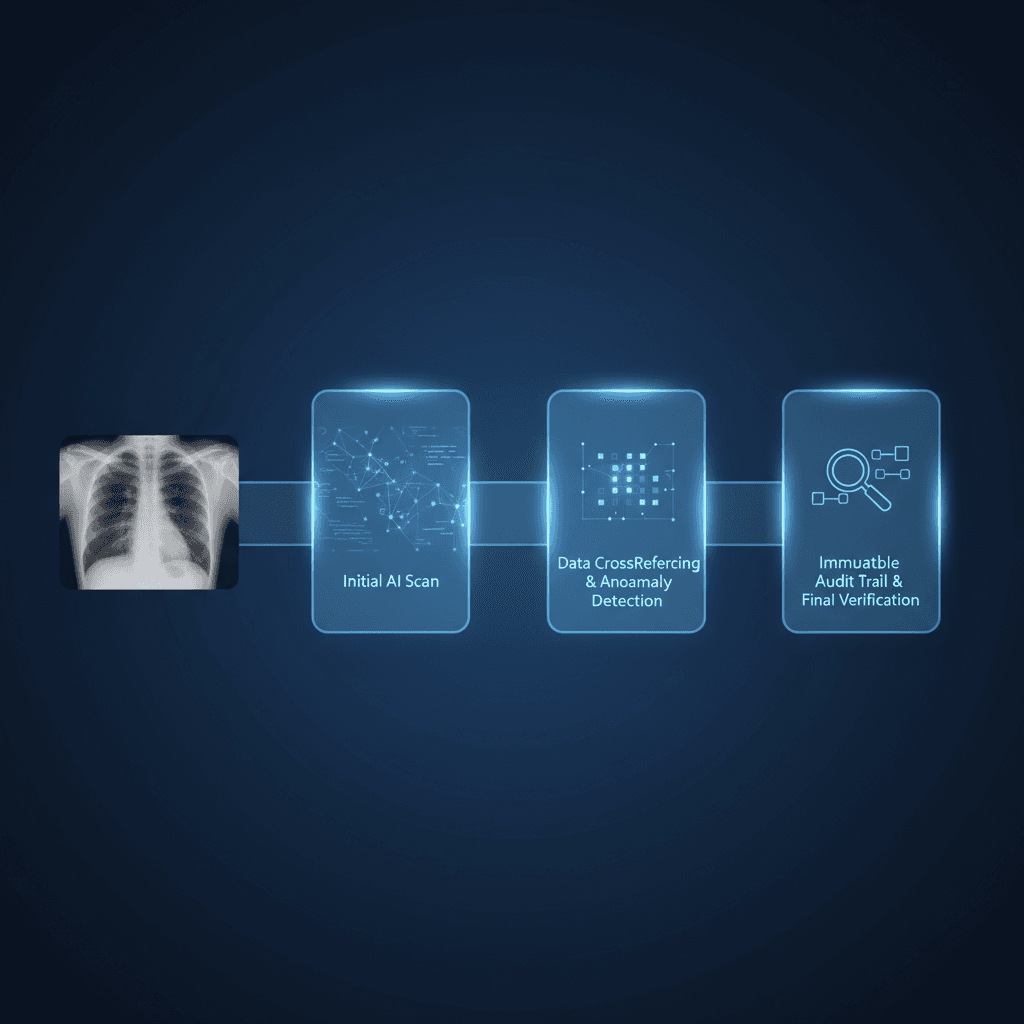
VeriMed is the system Teral uses to verify that every X-ray and clinical photo is authentic and belongs to the case it accompanies. Here's how it works — and why the final decision is always made by a human.

Unlocking predictive medicine's potential through centralized clinical data and global collaboration.

A practical guide for medical directors and CIOs on selecting and integrating AI medical chat platforms to improve care and efficiency in Colombian healthcare institutions.
Book a demo and we'll show you the impact with your network's own numbers.