Start building a more resolutive network
Book a demo and we'll show you the impact with your network's own numbers.
VeriMed is the system Teral uses to verify that every X-ray and clinical photo is authentic and belongs to the case it accompanies. Here's how it works — and why the final decision is always made by a human.
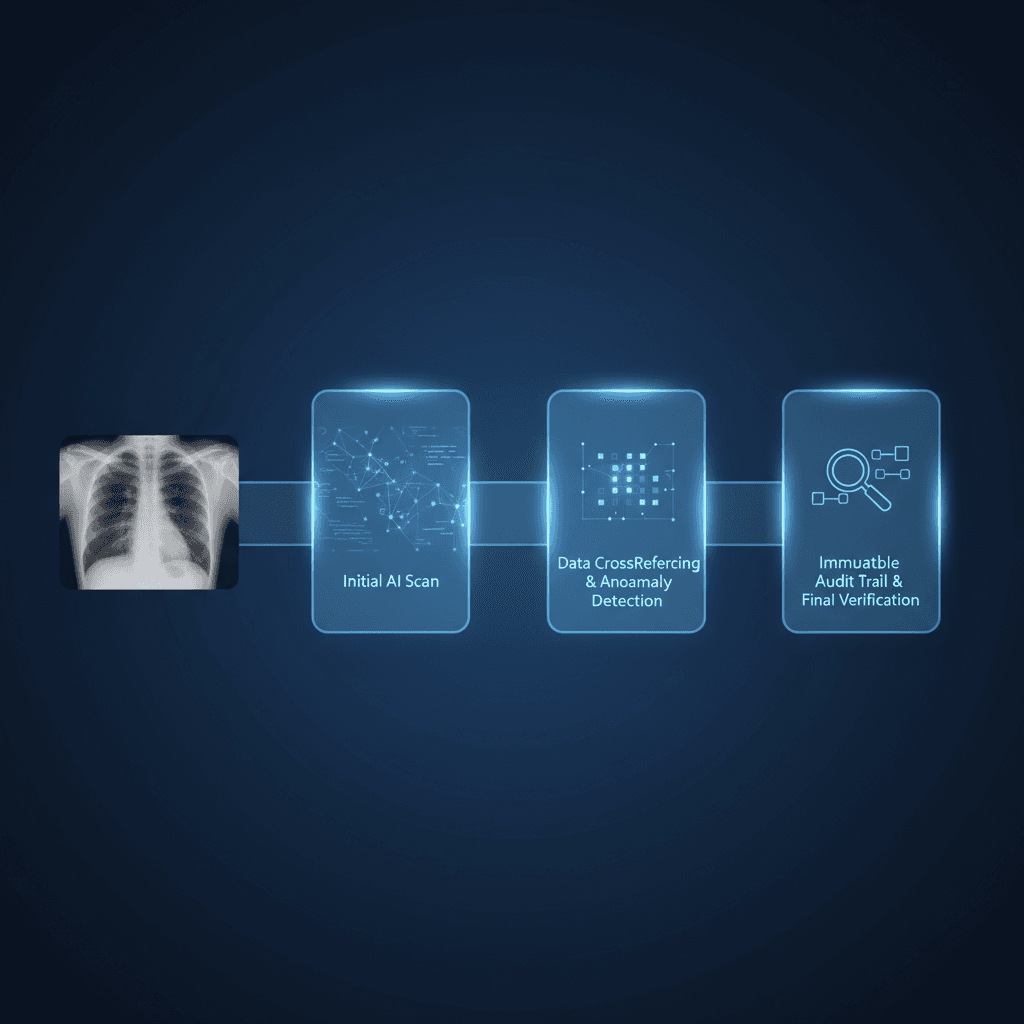
In a platform built around clinical cases and interconsultations, the medical image is the central piece of evidence. That makes it a target: when a case carries real value, the motivation to falsify it appears.
VeriMed is the system we use to verify that every image entering Teral is authentic and matches the case it accompanies. It doesn't rely on a single method — it applies six complementary verification layers that produce independent signals.
Those signals don't block anything on their own. They prioritize cases so a human can review them with all the evidence in front of them. The final decision is always made by a person.
A well-documented clinical case has real value inside Teral: it builds professional reputation, serves as training material for other physicians, and feeds the platform's knowledge base. That value is what makes the community work.
That same value creates an incentive to deceive. This isn't a hypothetical problem, nor one unique to Teral: any system where visual evidence supports a claim faces the same pressure. And as generative tools have matured, the cost of producing a convincing image has dropped considerably.
The types of falsification we're concerned about fall into three distinct categories:
The important point is that these three categories can't be detected the same way. Checking whether an image already existed on the platform is a different problem from evaluating whether it matches the text describing it. A system that only did one of the two would leave the other door open.
VeriMed doesn't rely on a single trick. It applies a set of complementary layers ranging from the fastest and cheapest to the most thorough. Each layer examines the image from a different angle and produces its own signal.
Evading one layer is possible. Evading all of them simultaneously is considerably harder.
That is the principle underlying the architecture. Robustness doesn't come from any single layer being infallible — it comes from the layers being heterogeneous: they analyze different things, with different techniques, and fail in different ways.
Reads the file's technical record: capture data, device, timestamps. Detects inconsistencies in the material's origin without looking at a single pixel.
Identifies files that are identical to others already on the platform, regardless of the filename or accompanying data.
Recognizes when it's the same image even if the file is different, looking at visual appearance rather than bytes. Recompression, cropping, or brightness adjustments don't fool it.
A vision model interprets the content of the image, not just its form. This makes it possible to find matches between images that look different but show the same thing.
A set of detectors dedicated to specific signals: recapture indicators, synthetic generation artifacts, and — using a multimodal model — whether the image is consistent with the case's clinical history. A chest X-ray described as a wrist fracture is an immediately obvious discrepancy for this analysis.
A fine-grained analysis that confirms whether two images correspond to the same physical specimen, even when orientation or framing differ.
Each layer contributes a signal. A scoring engine combines them into a risk level associated with the case, which determines whether it's worth having a person review it.
No image is automatically rejected.
VeriMed doesn't block. It prioritizes. When signals indicate risk, the case reaches a reviewer with all the evidence organized and a report explaining why the system flagged it. The decision is made by the person.
This decision isn't technical — it's ethical, and it's worth explaining clearly. The cost of wrongly accusing a legitimate professional is high: it affects their reputation, their relationship with the platform, and their trust in the system. An automated false positive isn't a minor software error; it's harm done to someone who did nothing wrong.
That's why the architecture is built to assist human judgment, not replace it. The detectors produce signals. The triage report, written by AI, contextualizes those signals in plain language. The reviewer decides in a click, with the full evidence in front of them. What AI contributes is speed and context — not verdicts.
Three pieces of artificial intelligence work at different points in the pipeline, each with a bounded function.
Vision models. They represent each image as a vector capturing its visual meaning. This enables semantic similarity search: finding images that show the same thing, even if they don't resemble each other as files. It's what makes comparing a new image against the full historical archive possible in milliseconds.
Multimodal model. It evaluates the relationship between the image and the clinical text that accompanies it, and drafts the triage report that the reviewer reads. It's the component that translates technical signals into plain-language explanations.
Vector search at scale. The infrastructure that underpins the comparisons. Without it, matching each new image against the entire history wouldn't be feasible at upload time.
One detail that matters: the detection is calibrated with clinical imaging material, not general photography datasets, and internal testing is limited to synthetic or effectively anonymous information. An X-ray doesn't behave like a vacation photo. Compression artifacts, contrast ranges, and capture characteristics are different — a detector trained on natural photos produces noise when confronted with medical material.
Verifying clinical images requires processing them, and that means being explicit about what is kept and what isn't.
It's worth being precise about the system's status, because there's a real difference between a working pipeline and a fully operational system.
As of July 2026:
VeriMed is a system in progress and in evolution. We don't present it as infallible or as a certified medical device, because it's neither. It's an integrity layer that grows with the platform and adjusts with every decision a reviewer makes.
Try it here with example cases and watch the pipeline analyze them in real time. Real images are analyzed in a pilot, with agreed access and conditions.
Prueba VeriMed con casos de ejemplo. Para analizar un caso real, coordinemos previamente las condiciones y el acceso adecuado.
Synthetic content detection is an arms race: every improvement in generation demands a response in detection, and that dynamic has no clear endpoint. Betting everything on detecting fakes is betting on winning an endless race.
The long-term defense isn't detecting fake images better. It's being able to verify the origin of the real ones.
That's where we want to take VeriMed. An image captured inside the application, with content credentials accompanying the file from the moment of capture, doesn't need to be analyzed to determine authenticity — its origin is verifiable by construction. The detection layers will still be needed for everything that enters through other channels, but verifiable provenance is the foundation you can build on for the next ten years.
While those technologies mature, the architecture is ready to incorporate them without being rebuilt.
This article describes VeriMed's layers and the principles that govern them, but deliberately does not publish thresholds, decision parameters, specific model names, or detection metrics. Detailing that information would make it easier for someone trying to circumvent the system — which would defeat the purpose of having it.
We compared Teral AI with Claude Sonnet 4.5 across 300 real specialist consultations in three specialties. Retrieval provides its greatest advantage where clinical practice needs it most.
Unlocking predictive medicine's potential through centralized clinical data and global collaboration.
A practical guide for medical directors and CIOs on selecting and integrating AI medical chat platforms to improve care and efficiency in Colombian healthcare institutions.
Book a demo and we'll show you the impact with your network's own numbers.